What does sitting too much do to your body?
Sitting too much damages almost every system in your body. Your sugar metabolism deteriorates, your fitness declines, you lose muscle mass, the blood flow to your brain decreases and your inflammation levels rise. And the uncomfortable news: that also applies if you exercise enough.
This article is based on a 60-page review article in Physiological Reviews (Pinto et al., 2023), one of the leading journals in physiology. I am Sander Kers, exercise scientist and author of, among other things, 'No Strong Story About Muscle Growth'. In this article I translate the main findings into things you can already do today. Do you find this interesting? Follow us on Instagram or Linkedin, as this will be a series of 5 more articles.
Exercise and sports are two separate things
For a long time, researchers used 'sedentary' as a synonym for 'too little exercise'. But that view is outdated. Too much sitting and too little exercise are two separate things on the same movement continuum. An adult can easily meet physical activity guidelines and still sit 10 hours a day. And that combination, active but prolonged sitting, is more vulnerable than you might think.
The average adult sits between 5 and 11.5 hours a day. That is a large part of the waking hours. The muscle tension in your legs is 2 to 2.5 times higher when standing than when sitting. While walking, it increases to 7 to 10.5 times higher, and during stair climbing to 18 times. That difference in muscle activity throughout the day is the crux of the problem.
What exactly too much sitting does to your body
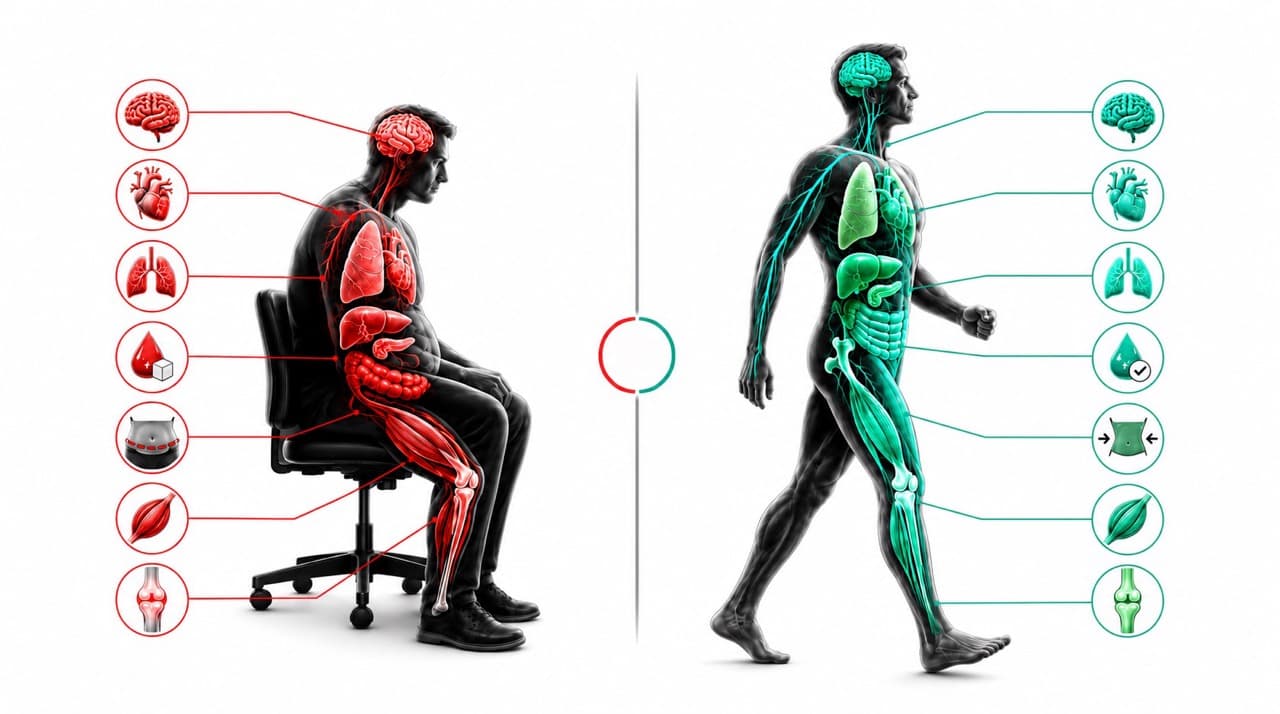
In this review article you will read the introduction about six systems of what sitting does to you. In the next series I will go deeper into each system.
Sugar metabolism and weight. After just one day of sitting a lot, insulin sensitivity decreases by an average of 39 percent. After two weeks, body fat percentage increases by 3 to 14 percent and abdominal fat mass increases by about 7 percent. Post-meal blood sugar levels rise, blood sugar fluctuations increase and your body burns less fat.
Heart, blood vessels and fitness. After 30 minutes of sitting, blood flow in your legs already measurably decreases. Two weeks of little activity decreases your fitness (VO2max) by 6.6 percent. Two weeks of sitting results in a decline in fitness that normally requires 7 years of aging.
Muscles and bones. Muscle mass and strength decrease rapidly. In studies with step or movement restriction, participants lost 1.3 to 9 percent muscle mass, depending on the duration and approach. Strength decreased by 8 to 25 percent. Muscle protein synthesis dropped by 25 to 50 percent and bone density decreased in the load-bearing bones.
Brain. After four to six hours of uninterrupted sitting, blood flow velocity to the brain decreases by 3 to 6 percent. After eight hours, participants scored worse on working memory, executive function, and visual learning. These are exactly the factors that, in the long run, are associated with cognitive decline.
Inflammation. The inflammation marker IL-6 increased by 38 to 50 percent after three to five hours of sitting. After two weeks of little activity, CRP and TNF-alpha also increased (more on this in the last article of this series), and in older participants, these remained elevated even after two weeks of recovery.
Why an hour of exercise doesn't fully recover this
In studies where people lay in bed all day except when they trained, some adverse effects of prolonged stillness remained. Think of worse fat metabolism, measured insulin resistance, and elevated triglycerides. Even training above normal physical activity guidelines did not always compensate for this.
The explanation lies in biology. Muscle contractions throughout the day activate enzymes, such as lipoprotein lipase, which are involved in the processing of fats and sugars. These enzymes respond to light, frequent activity and much less to intensive but short exertion. A heavy workout in the evening does not replace the continuous light muscle activity of a day of movement.
How long is too long?
There is no hard limit, but the research provides clues. Effects on circulation in the legs are measurable after 30 minutes. After two hours of uninterrupted sitting, vascular function and blood sugar regulation begin to noticeably deteriorate. An observational research limit of 9.5 hours a day is associated with a higher risk of premature death.
What you can do to limit the damage
The good news: you don't need to reserve an hour for it. Short movement breaks spread throughout the day are most effective. Studies point to a simple pattern.
Stand up and move for 2 to 6 minutes every 20 to 60 minutes.
Light to moderate intensity is sufficient. Think walking, a few squats, or calf raises.
More frequent and slightly more active is better for your blood sugar than occasional and only standing.
Even fidgeting with your legs helps to maintain circulation.
Walk shortly after a large meal. That's precisely when it improves your blood sugar response.
Being honest about expectations: in healthy people, the effects are small but measurable. In people with overweight, type 2 diabetes, or high blood pressure, the effects are larger. It is not a substitute for sports, but an addition to your daily routine.
Frequently Asked Questions
How many hours of sitting per day is too much? There is no officially established limit, but observational research points to an increased risk at more than 9.5 hours of objectively measured sitting time per day. Experimental studies already show measurable effects on blood sugar and circulation after two hours of uninterrupted sitting.
Is standing a good alternative to sitting? Standing is better than sitting, but less effective than walking or active movement. Studies show that standing does improve blood sugar slightly, but for blood pressure and vascular stiffness, light active movement is more effective than just standing.
Can an hour of exercise per day compensate for the damage of sitting for 10 hours? Partly, but not completely. Exercise significantly reduces the risk, but bed rest studies show that even training above physical activity guidelines does not completely counteract some effects of prolonged stillness. Both are relevant: enough exercise and little uninterrupted sitting.
How quickly can I see improvement if I start moving more in between? Blood sugar and blood pressure improve acutely, already with the first breaks. Effects on fitness, muscle mass, and weight take weeks to months. In studies that reduced step counts, many negative effects returned to normal within two weeks after participants started moving normally again.
Does this also apply to children and adolescents? Yes, although the evidence is more limited for younger age groups. Screen time and sedentary behavior are also associated with unfavorable metabolic risk factors in children. School interventions with sit-stand desks, however, had varying results.
What if my job requires me to sit all day Then the movement breaks are most relevant for you. Set a timer for 25 to 30 minutes, stand up during phone calls, place water not on your desk but on the other side of the room. Small environmental adjustments work better than willpower alone.
Source
Pinto AJ, Bergouignan A, Dempsey PC, Roschel H, Owen N, Gualano B, Dunstan DW. Physiology of Sedentary Behavior. Physiol Rev. 2023;103(4):2561-2622. doi:10.1152/physrev.00022.2022.
START TRAINING SERIOUSLY
Discover new training methods based on scientific knowledge, improve your form and technique and seriously track your fitness goals.
Already a member? Get the app