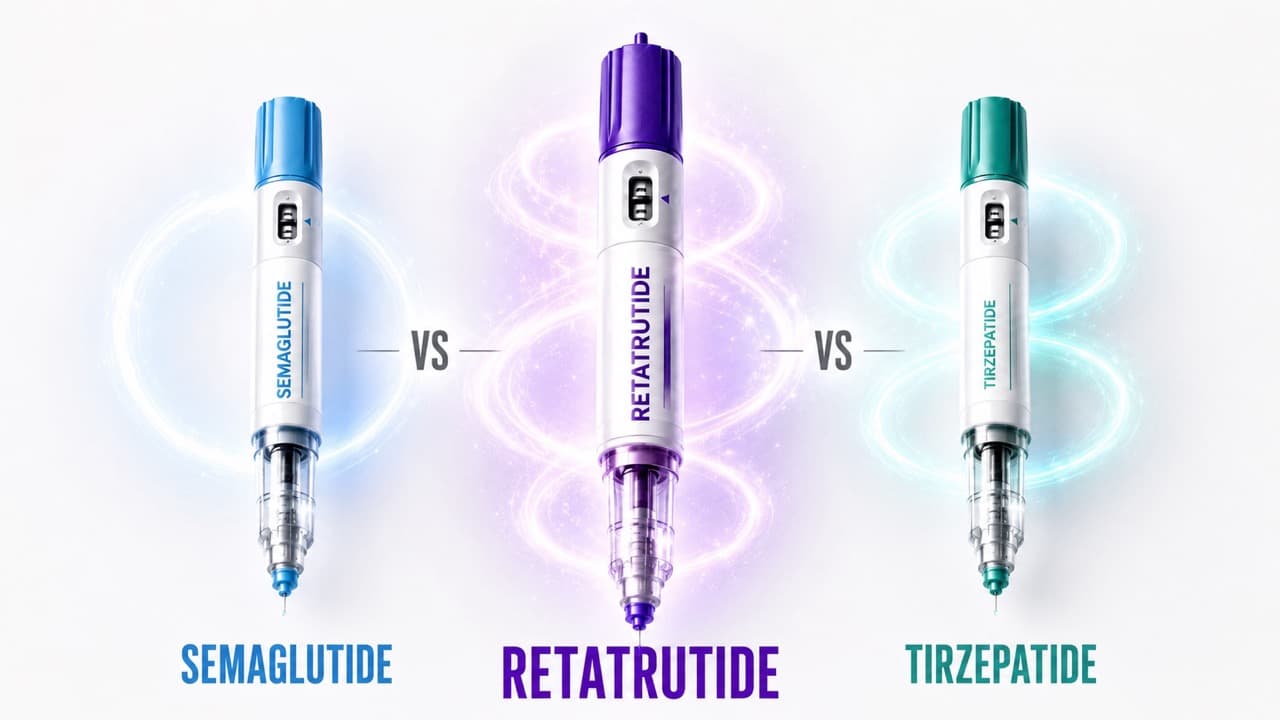
Retatrutide versus Ozempic and Mounjaro: how much weight do you lose and what does it do to your muscles?
On June 6, 2026, a major new study on retatrutide was published in the scientific journal The Lancet. Retatrutide is a weight loss and diabetes drug that isn't for sale yet, but that achieves higher numbers in testing than Ozempic and Mounjaro.
Time for a sober look. What is it, how does it work, how much weight do you lose, and what happens to your muscle mass in the meantime?
What's the difference between Ozempic, Mounjaro and retatrutide?
These three drugs look alike, but work in slightly different ways.
After eating, your body produces hormones that tell you you're full and that regulate your blood sugar. Weight loss medication mimics those hormones. The difference is in how many hormones get mimicked at the same time.
Semaglutide (known as Ozempic for diabetes and Wegovy for weight loss) mimics one hormone: GLP-1.
Tirzepatide (Mounjaro for diabetes, Zepbound for weight loss) mimics two: GLP-1 and GIP.
Retatrutide mimics three: GLP-1, GIP and glucagon.
More buttons, more effect. But what do these three hormones actually do?
What exactly do GLP-1, GIP and glucagon do?
This is going to get a bit technical. These drugs are called "receptor agonists." A receptor is basically a lock on your cells, and an agonist is the key that fits that lock and turns it on. A GLP-1 receptor agonist is therefore something that opens the GLP-1 lock and thereby mimics or activates the effect of GLP-1.
GLP-1 is released in your gut after you eat. It tells your pancreas to make insulin (lowering your blood sugar), slows down how fast your stomach empties, and sends your brain the signal that you're full. In short: less hunger, lower blood sugar.
GIP is also a gut hormone. It boosts insulin release after eating and plays a role in how your fat tissue handles nutrients. Together with GLP-1 it strengthens the effect on your blood sugar and weight.
Glucagon is the new addition in retatrutide. Under normal circumstances glucagon does the opposite of insulin: it raises your blood sugar. So why add that to a weight loss drug? Because glucagon also does a few other useful things: it raises your energy expenditure (you burn more), it kickstarts fat burning in your liver, and it suppresses your appetite.
The reason glucagon works comes down to the combination with the other hormone mimics.
Glucagon on its own would push your blood sugar up, but because it's combined with GLP-1 and GIP (which strongly lower blood sugar), that downside gets cancelled out. What's left is the upside: extra fat burning and higher energy expenditure. The study indeed shows that adding glucagon doesn't get in the way of the blood sugar drop. That's exactly why retatrutide appears a bit more powerful than Ozempic and Mounjaro.
How much weight do you actually lose?
The new study (TRANSCEND-T2D-1) looked at 537 people with early-stage type 2 diabetes, who were still trying to manage their diabetes with diet and exercise alone. For 40 weeks they got a weekly injection of retatrutide (4, 9 or 12 milligrams) or a placebo injection.
The average starting weight was 96.9 kilos. After those 40 weeks, here's what happened:
At 4 mg: an average of 11.1 kilos lost (11.5%).
At 9 mg: 13.5 kilos (13.9%).
At 12 mg: 15.1 kilos (15.3%).
Placebo: 2.7 kilos (2.6%).
Blood sugar improved significantly, and at the highest dose more than 70% of participants lost over 10% of their body weight. A notable detail: after 40 weeks the weight loss hadn't leveled off yet. That means the participants probably weren't "done" losing weight when the study ended.
How does this compare to the drugs we already know? Note that you can't directly line up studies side by side (different people, different durations), so take this with a grain of salt. In people with diabetes (and often a lower dose), you roughly see: about 5% weight loss with semaglutide, around 11% with tirzepatide, and about 15% with retatrutide. In people with obesity without diabetes (and a higher dose), everything sits higher: roughly 15% with semaglutide, 15 to 21% with tirzepatide, and up to 24% with retatrutide after an average of 48 weeks. Real head-to-head comparisons between the three drugs are still ongoing.
Did they also get help with eating and exercise alongside the injection?
A little. Participants received nutritional advice (a healthy eating pattern with attention to good macronutrients and enough fluids) and were asked to maintain their usual activity level.
However, their food intake and exercise weren't tracked or controlled. The study says nothing about sleep guidance.
Did the participants do strength training? That's always a question I ask myself with this kind of research. We don't know. There was no strength training program in the study, and because activity wasn't measured, we can't say who trained and who didn't. Everyone kept their own habits. More on this later.
Is it for sale yet, and what does "phase 3" mean?
No, retatrutide isn't for sale yet, and that has everything to do with that "phase 3."
A new drug goes through a fixed pathway. Phase 1 tests in a small group whether it's safe and which dose works. Phase 2 tests in hundreds of people whether it actually works and what the best dose is. Phase 3 tests in hundreds to thousands of people whether it works and is safe, compared to a placebo or an existing drug. That's the last big testing phase before a company can apply for approval.
This study is such a phase 3 study. Retatrutide is therefore close to the end of the pathway. But the manufacturer hasn't even applied for approval yet, and the expectation is that the drug will be available at the earliest in 2027 or 2028.
That manufacturer is Eli Lilly and Company (which also funded this study). Retatrutide is known in science as LY3437943, where "LY" stands for Lilly. What's sold online through grey-market channels as "retatrutide" hasn't been tested for quality or safety. Don't go there. Semaglutide and tirzepatide are approved and available by prescription.
What are the side effects of retatrutide?
The most common side effects were gastrointestinal complaints: nausea, diarrhea and vomiting. These were generally mild to moderate and occurred mostly in the first weeks, while the dose was being gradually increased. After that they tapered off.
Between 2 and 5% of participants stopped due to side effects. Severe low blood sugar didn't occur. Two people died during the study, both in the lowest-dose group, and according to the researchers this was unrelated to the drug. This matches what we already know from Ozempic and Mounjaro.
How much muscle mass do you lose with weight loss medication?
This is where it gets interesting (in my opinion). The big diabetes study above only measured weight, waist circumference and BMI, not the split between fat and muscle. For that there's a separate study that did look at body composition (using a DEXA scan) during weight loss.
In that study, people on the highest dose lost about 17 kilos, of which roughly 10 kilos was fat and just over 6 kilos was fat-free mass. Note: fat-free mass isn't the same as pure muscle mass (it also includes fluid and organ tissue), but a large part of it is indeed muscle mass. In this example, roughly a third of what was lost was not fat.
Is that a lot? A large review study of all GLP-1-type drugs shows that on average about a quarter of weight loss consists of fat-free mass. The fat-to-muscle ratio with retatrutide is roughly similar to that with the other drugs. Reassuring, but there's a catch: the more powerful the drug, the more kilos you lose overall, and so the more kilos of muscle mass you lose in absolute terms. The strongest drugs (including retatrutide) make you lose the most weight, but as a result also cost you the most muscle.
And muscle is your engine. It keeps you strong, regulates your blood sugar, and protects you against frailty as you get older. As a movement scientist I like to hammer on this point: especially with the strongest drugs, you want to protect that engine.
Does strength training help against muscle loss? And the studies now looking into this
Logically you'd think: yes, but you never keep everything, and building muscle at this rate of weight loss is, in my view, physiologically not possible. Here's what is and isn't known:
Large studies directly testing whether strength training counteracts muscle loss with retatrutide don't exist yet. There is, however, a small case series of people who did strength training 3 to 5 times a week during their semaglutide or tirzepatide course and ate a lot of protein (around 1.6 to 2.3 grams of protein per kilo of fat-free mass). In them, muscle mass wasn't just preserved, two out of three even built muscle while losing significant weight (I hope this is accurate, but I have my doubts). For comparison: in the large drug studies, without a strength training program, 26 to 40% of weight loss was fat-free mass.
That's not hard proof (these are individual cases, not comparative research), but it lines up with what we already know about strength training during weight loss.
Now for the best part: there are currently large, well-designed studies running that are specifically looking into what strength training and protein do during weight loss with medication. One of these (the so-called LEAN-PREP study) splits people starting on this medication into groups: medication only, medication plus strength training, medication plus extra protein, or all combined. In a while we'll know much better what strength training really adds.
Want to get started with a solid strength training program yourself? Check out our Serious Fitness Lab app
What are the limitations of this research?
No study is perfect.
The study lasted 40 weeks, and it's not yet known what the lost weight (and blood sugar values) look like after stopping the medication for 40 weeks.
Participants came from only three countries (India, Mexico and the US) and all had only recently developed diabetes and were barely on medication yet. So the results don't simply apply to everyone.
The study was funded by the manufacturer, who was also involved in setting it up, analyzing it and writing it up. That doesn't make it invalid, but it's something to keep in mind.
In conclusion
Retatrutide looks promising and is probably more powerful than what's currently on the market, but it's not for sale yet. It comes with the same side effects, and however good a drug is: part of what you lose is muscle mass.
Frequently asked questions about retatrutide
Is retatrutide for sale or approved yet? No. Retatrutide is still in phase 3, the last testing phase. The manufacturer hasn't applied for approval yet. It's expected to be available at the earliest in 2027 or 2028.
What's the difference between retatrutide, Ozempic and Mounjaro? Ozempic (semaglutide) acts on one hormone system (GLP-1), Mounjaro (tirzepatide) on two (GLP-1 and GIP), and retatrutide on three (GLP-1, GIP and glucagon). That extra hormone, glucagon, provides a bit more fat burning and energy expenditure.
How much weight do you lose with retatrutide? In the diabetes study, people on the highest dose lost an average of 15.1 kilos (15.3% of their body weight) in 40 weeks. In people with obesity without diabetes, earlier research showed this going up to about 24% after 48 weeks.
Do you lose muscle mass with weight loss medication? Yes, partly. With these kinds of drugs, on average about a quarter to a third of weight loss is fat-free mass, of which muscle mass makes up a large share. The more total weight you lose, the more muscle mass you lose in absolute terms.
Does strength training help against muscle loss with GLP-1 medication? Probably yes. The first case reports show that people who train and eat enough protein can preserve their muscle mass. Solid proof from large studies is still to come; those are currently underway.
What are the side effects of retatrutide? Mainly gastrointestinal complaints such as nausea, diarrhea and vomiting, usually mild and mostly in the first weeks. This matches Ozempic and Mounjaro.
Who makes retatrutide? Retatrutide (codenamed LY3437943) is being developed by the pharmaceutical company Eli Lilly and Company.
Sources
Bajaj, H. S., Welch, M., Shah, P., et al. (2026). Efficacy and safety of retatrutide in people with type 2 diabetes (TRANSCEND-T2D-1): A phase 3 trial. The Lancet, 407, 2402–2413.
Jastreboff, A. M., Kaplan, L. M., Frias, J. P., et al. (2023). Triple-hormone-receptor agonist retatrutide for obesity: A phase 2 trial. The New England Journal of Medicine, 389, 514–526.
Coskun, T., Wu, Q., Schloot, N. C., et al. (2025). Effects of retatrutide on body composition in people with type 2 diabetes: A substudy of a phase 2 trial. The Lancet Diabetes & Endocrinology, 13, 674–684.
Karakasis, P., Patoulias, D., Fragakis, N., & Mantzoros, C. S. (2025). Effect of GLP-1 receptor agonists and co-agonists on body composition: Systematic review and network meta-analysis. Metabolism, 164, 156113.
Tinsley, G. M., & Nadolsky, S. (2025). Preservation of lean soft tissue during weight loss induced by GLP-1 and GLP-1/GIP receptor agonists: A case series. SAGE Open Medical Case Reports, 13.
ClinicalTrials.gov. (n.d.). LEAN-PREP study (Identifier No. NCT06885736). U.S. National Library of Medicine.
START TRAINING SERIOUSLY
Discover new training methods based on scientific knowledge, improve your form and technique and seriously track your fitness goals.
Already a member? Get the app