What Does Sitting Too Much Do to Your Metabolism and Weight?
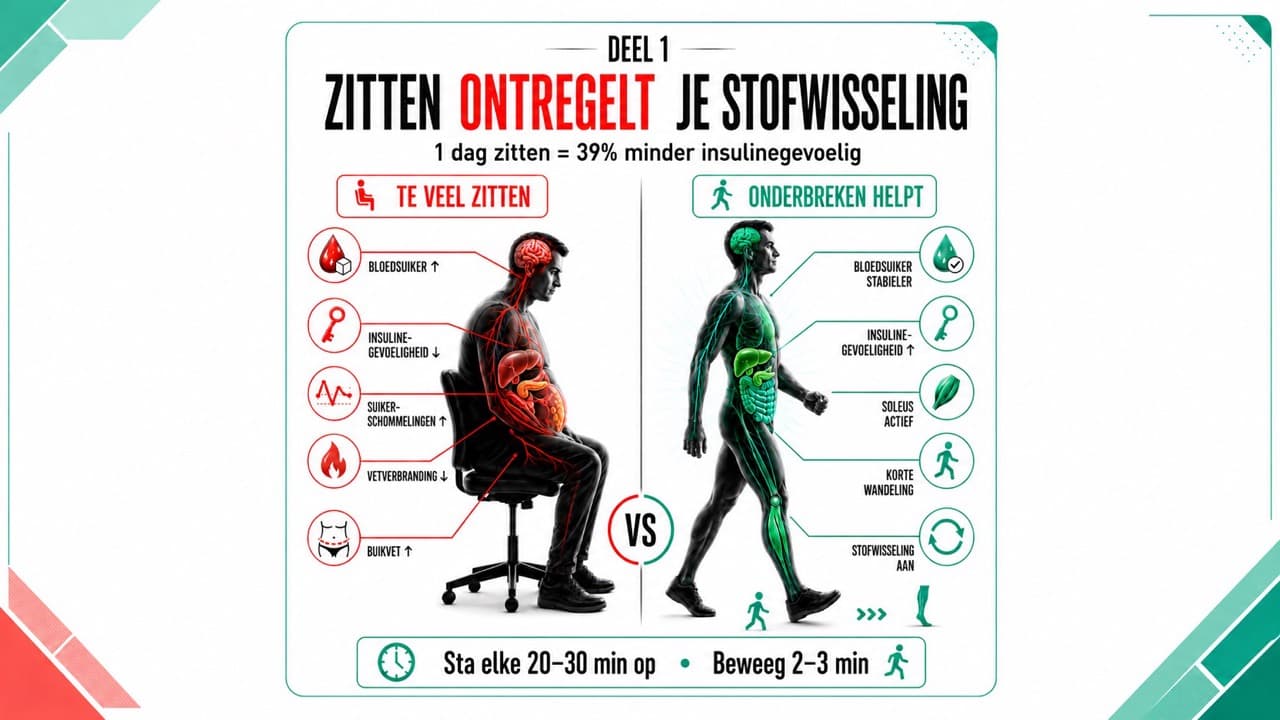
Insulin sensitivity drops by an average of 39 percent after just one day of sitting a lot. Not after a week or a month. After one day. And even if you eat less that day to compensate for the lower energy expenditure, that only partially resolves the insulin resistance. Sitting itself disrupts your metabolism, independently of your calorie intake.
Insulin resistance begins after just one day of sitting
In an experiment, insulin sensitivity in healthy adults was measured after a day of 17 hours of sitting. The result: a 39 percent decline compared to a day with minimal sitting. When participants adjusted their calorie intake to match their lower energy needs, the decline dropped to 18 percent, but it did not disappear.
After seven days in a highly sedentary state, blood sugar two hours after a sugar drink rose significantly and insulin sensitivity dropped by 17 percent.
After two weeks of greatly reduced activity, the body became much worse at processing sugar. Whole-body insulin sensitivity dropped by 58 percent, meaning cells respond far less well to the signal to take up glucose. Interestingly, blood sugar in many participants appeared normal on the surface. But that was misleading: the pancreas had to produce more and more insulin to keep blood sugar stable. Your body compensates, but it costs increasing effort. Think of a car that has to rev harder to maintain the same speed. On paper it still drives fine, but under the hood something is wrong.
You burn less but you do not eat less
When you sit, you burn less energy. That makes sense. But your appetite does not automatically adjust. One experiment showed that participants ate just as much after a day of greatly reduced activity, despite burning 24 percent less energy. The combination of lower burning and unchanged intake pushes you toward a positive energy balance. You gain weight slowly without noticing.
At the same time, your fuel choice changes. Your body starts burning more carbohydrates and less fat. Researchers call this metabolic inflexibility: the body's ability to smoothly switch between carbohydrates and fats as fuel becomes impaired. This is an early signal that metabolism is going off balance, even before your blood sugar values reach danger territory.
What two weeks of low activity does to your body composition
In studies where participants greatly reduced their daily step count, body fat percentage increased by 3 to 14 percent and abdominal fat mass by an average of 7 percent. Body weight increased slightly, but the real shift was in the ratio of fat to muscle: more fat, less muscle.
The good news is also here: in a study where participants then resumed normal activity, most of the negative effects on body composition returned to baseline within two weeks. Your body is remarkably responsive, in both directions.
Sitting can also block the gains from your workout
This may be the most surprising part of the research. Too much sitting can block the metabolic benefits of exercise.
In one study, healthy, active men sat for more than 14 hours per day for four to five days and took only 1,650 steps. On day four they did one hour of intense training. The result: triglycerides after the meal remained elevated, even after that hour of exercise. Training did not neutralize the damage from sitting.
Another study showed that at a daily step count of 5,000 or fewer, post-meal fats were already 22 to 23 percent higher and fat burning 14 to 19 percent lower, compared to 8,500 steps per day. That is the threshold at which your training loses its full effect.
You can train hard and still have a poor fat metabolism if you sit still for the rest of the day.
The power of a small calf muscle
One of the most striking findings involves the soleus, a small calf muscle that consists of approximately 88 percent slow, oxidative muscle fibers. These are precisely the fibers that are good at continuously burning fat and sugar over long periods.
By continuously and rhythmically contracting this muscle through so-called soleus push-ups (lifting the heel while seated), regulation of blood sugar and fats improved substantially. Blood sugar three hours after a meal dropped by 39 to 52 percent. The insulin response dropped by 41 to 60 percent.
A muscle that accounts for less than 1 percent of your total body mass can therefore have a system-wide effect on your metabolism. That shows it is not about the intensity of the effort but about the frequency of muscle contractions throughout the day.
Which movement break works best for blood sugar?
Multiple large review studies (meta-analyses) show that interrupting prolonged sitting with short periods of light to moderate activity improves postprandial blood sugar by an average of 17.5 percent and reduces the insulin response by 25.1 percent, compared to uninterrupted sitting. Just standing without moving helps less than walking or simple exercises.
The optimal frequency has not been precisely established, but studies point to breaks of 2 to 6 minutes every 20 to 60 minutes. Longer and more frequent breaks appear to work better for total daily blood sugar control.
Women, people with higher body weight, people with insulin resistance and people with lower fitness seem to benefit more from movement breaks than their healthy, lean counterparts. Those who need it most also have the most to gain.
If you want to gain even more health benefits: start strength training
The biggest health gain, if you sit a lot, comes from interrupting your sitting as often as possible. If you also want to slow down aging and significantly improve the way you age, start strength training. Muscle mass, and especially a little more muscle mass, slows down every aging process and makes life better right now.
Don't know where to start? Check out our Serious Fitness Lab app.
Frequently asked questions
How quickly will I notice the effects of movement breaks on my blood sugar?
Acutely, on the same day. In laboratory studies, blood sugar response after a meal improved with the very first break. After three days of regular breaks, that improvement was sustained into the following day as well.
Is it enough to eat less if I sit more?
No, not fully. Eating less reduces the drop in insulin sensitivity but does not eliminate it. Sitting itself disrupts metabolism through mechanisms beyond energy balance alone. Eating less helps, but it is not enough.
Which type of movement works best as a break?
Walking works better than standing alone. Squats and calf raises also work well and have additional benefits for muscle protein synthesis. For blood sugar, more frequent shorter breaks appear slightly more effective than less frequent longer ones.
Is this research also relevant for people with type 2 diabetes?
Yes, and the effects are even larger in this group. Studies in people with type 2 diabetes showed greater improvements in fasting insulin, 24-hour blood sugar and the duration of high blood sugar episodes with regular breaks compared to uninterrupted sitting.
Can I compensate with an evening workout?
Partly. Exercise significantly improves insulin sensitivity and metabolism. But bed rest studies show that training above exercise guidelines does not fully restore fat metabolism and insulin response when a lot of sitting also occurs. Both matter: exercising regularly and taking regular movement breaks throughout the day.
Are there nutritional strategies that help alongside movement breaks?
This falls outside the scope of this review. What is clear: overeating combined with sitting significantly worsens the metabolic effects. It is therefore wise not to overeat on days when you move little.
Source:
Pinto et al. (2023). Physiology of sedentary behavior. Physiological Reviews, 103(4), 2561–2622.
START TRAINING SERIOUSLY
Discover new training methods based on scientific knowledge, improve your form and technique and seriously track your fitness goals.
Already a member? Get the app