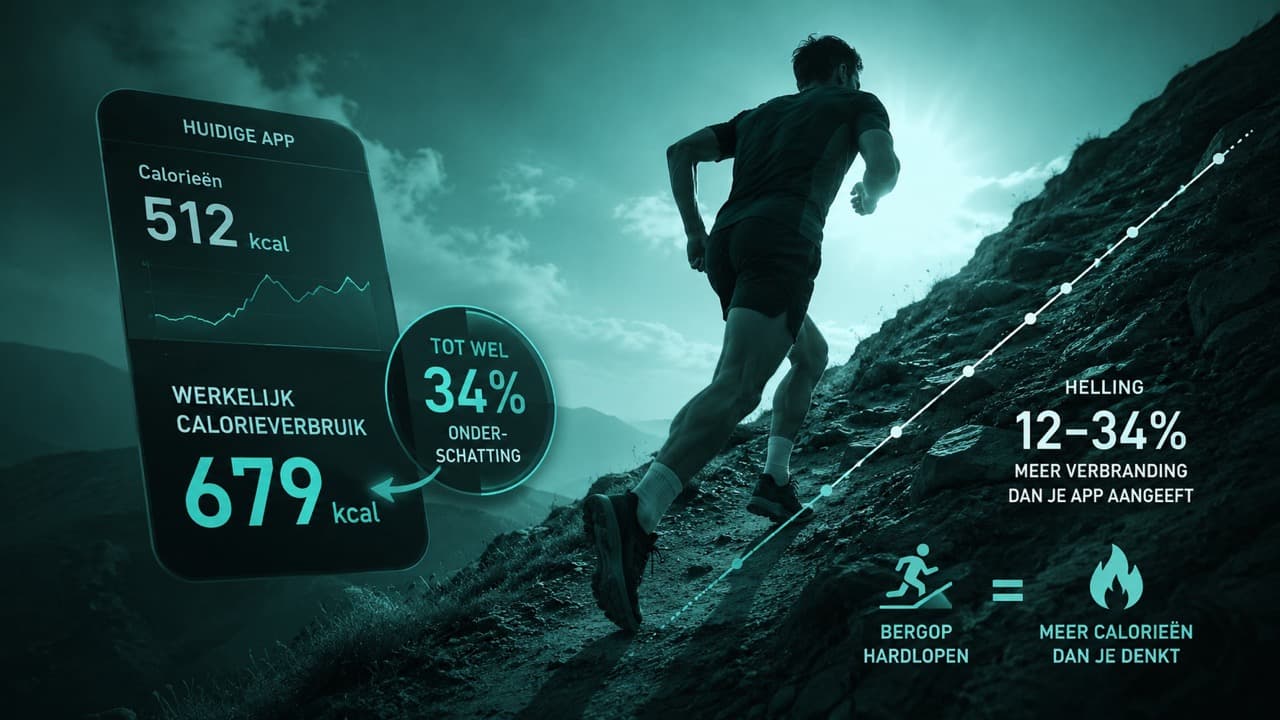
How many calories do you really burn running uphill?
Your running app is off by up to 34 percent. The formula almost every running app uses to calculate your calorie burn on hills dates back to 1975 and is simply wrong. On flat terrain, your app overestimates your burn by around 12 percent. On steep hills, that same app underestimates your burn by 12 percent or more, reaching up to 34 percent on extreme gradients. Researchers at the University of Massachusetts used data from 673 runners across 38 studies to develop two new, far more accurate formulas. One of them is called the RE3, which stands for Running Energy Expenditure Estimation. It was only published in 2025, so the chance that your app already uses it is essentially zero.
Why running uphill costs so much more than you think
On flat terrain, an 80 kilogram runner at 10 kilometers per hour burns roughly 790 kilocalories per hour. At 8 percent gradient, that rises to 1185 kilocalories per hour. That is 50 percent more. At 15 percent gradient at a slightly slower pace, it is 67 percent more than on flat terrain.
The reason is straightforward. On flat ground, you only move yourself forward. Going uphill, you add something to that: you lift your own bodyweight against gravity. And muscles are poor lifts. Of every 100 calories you burn, only 23 go toward actually moving upward. The other 77 disappear as heat. That is also exactly why you sweat so much when running uphill.
Scientists call that 23 percent the energy efficiency of muscles during vertical work. The old 1975 formula assumed more than 50 percent efficiency. That is physiologically impossible, and we have known this for decades from cycling and muscle studies. Yet that assumption is still quietly sitting inside the software of your running watch.
Downhill running is not free
On a gentle 5 percent descent, running does cost less energy. For that same 80 kilogram runner, that is around 620 kilocalories per hour, which is 21 percent less than on flat ground. Gravity does part of the work.
But on steep descents, that story reverses. Your muscles have to brake hard to stay in control going downhill. That braking movement costs a surprising amount of energy and is also the reason you feel more muscle soreness the day after a downhill route than after climbing. The cheapest point for your energy expenditure is somewhere between 10 and 20 percent downhill gradient. Steeper than that and your burn goes back up.
What can you do with this in practice?
For an easy run on flat terrain, this changes little. But if you are getting serious about trail running or hilly routes, and you are planning your nutrition based on those calorie estimates, an error of 20 to 34 percent can be very noticeable by kilometer 25.
The researchers built a free online calculator based on the new RE3 formula. Enter your weight, speed and gradient and get a reliable estimate. You can find it at sites.google.com/umass.edu/umill/calculator.
Beyond that, the usual principles apply. Well structured training, adequate recovery and an app that helps you track your progress. Serious Fitness Lab has over 400 training programs, written on the basis of current research, for every level and goal. Free to try for seven days.
Frequently asked questions
Which running apps already use the new RE3 formula? Probably none. The RE3 formula was only published in 2025 in the European Journal of Applied Physiology. Garmin, Strava and Apple still use variants of the old 1975 ACSM formula or their own proprietary calculations that are not publicly disclosed.
How many more calories do I burn running uphill compared to flat? It depends on your weight, speed and gradient. As a rough guide: at 8 percent gradient, an 80 kilogram runner at 10 kilometers per hour burns around 50 percent more calories than on flat ground. At 15 percent gradient at a slightly slower pace, that is 67 percent more. Use the free RE3 calculator from the University of Massachusetts for an accurate estimate for your specific situation.
Does running downhill also cost more energy than running flat? On gentle descents up to around 10 percent, running downhill costs less energy than flat running because gravity assists you. On steep descents above 15 to 20 percent, your energy use goes back up because your muscles have to work hard to brake. Downhill running is not free, but on moderate gradients it is cheaper than flat running.
Why is the old ACSM formula still being used? Partly because it has been a well established standard in exercise science and sports medicine for decades. Partly also because apps and devices are not automatically updated when new science emerges. The formula is not bad for flat running, but on hills it significantly misses the mark.
Does it matter whether you are training for weight loss or performance? For weight loss, an error of 20 to 34 percent in your calorie estimate matters if you are tracking your nutrition based on those numbers. You end up thinking you burned less than you actually did, which skews your nutritional strategy. For performance focused runners and trail runners, accurate estimates also matter for nutrition planning during long runs and races.
Sources
Looney DP, Hoogkamer W, Kram R (2026). Metabolic energy expenditure during level, uphill, and downhill running. European Journal of Applied Physiology, 126, 1621–1633. https://doi.org/10.1007/s00421-025-05999-5
START TRAINING SERIOUSLY
Discover new training methods based on scientific knowledge, improve your form and technique and seriously track your fitness goals.
Already a member? Get the app