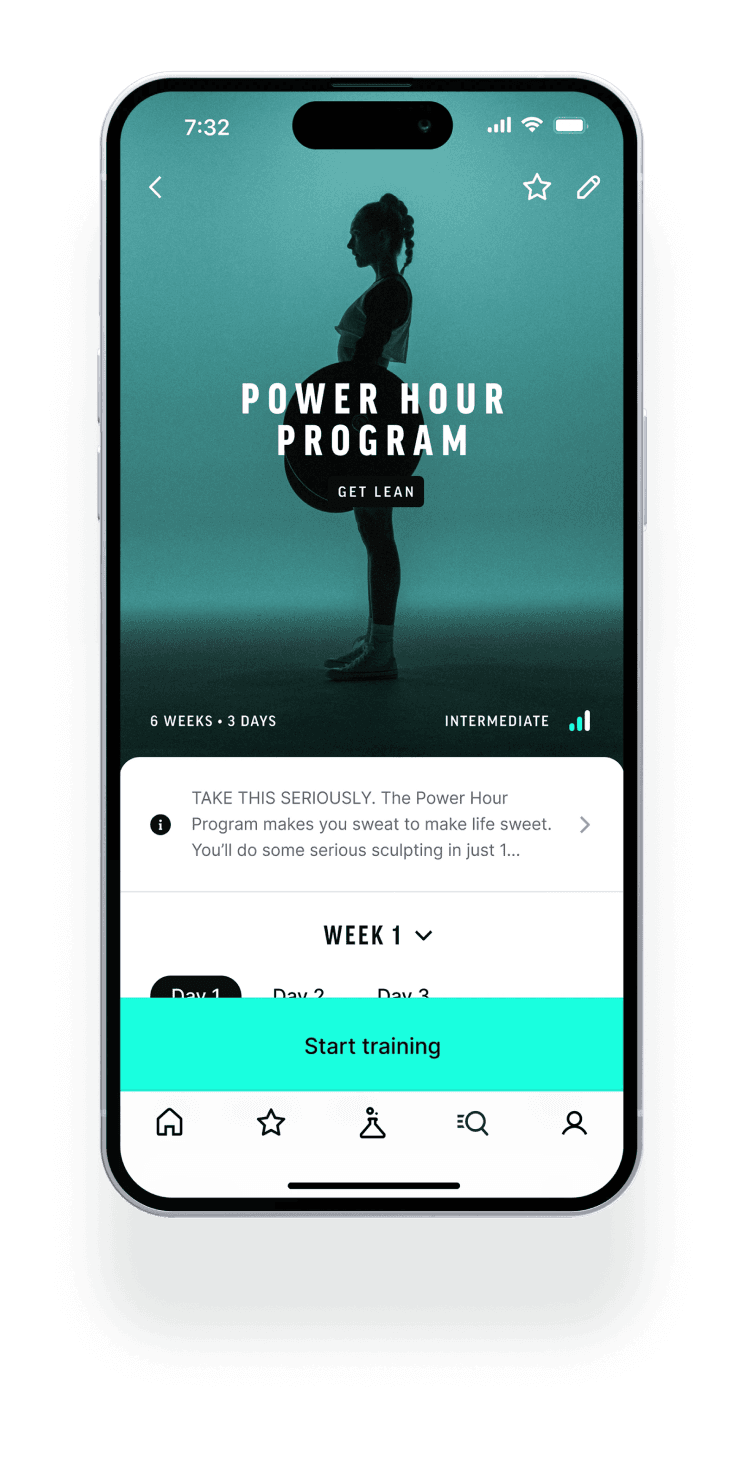
BUT SERIOUSLY...
Forget 'less is more'. With more cardio, more volume, more technique and more strength, this schedule is a challenging experiment that builds on the previous one. This is a serious banger!
Workout plan highlights
Crush all records is strength and conditioning at the highest gear and absolutely not for beginners. You simultaneously work on increasing your work capacity and strength. The emphasis per workout plan in this super series varies. Sometimes you do more for your conditioning and other times more for strength and muscle building. Let's go!
Featured exercises
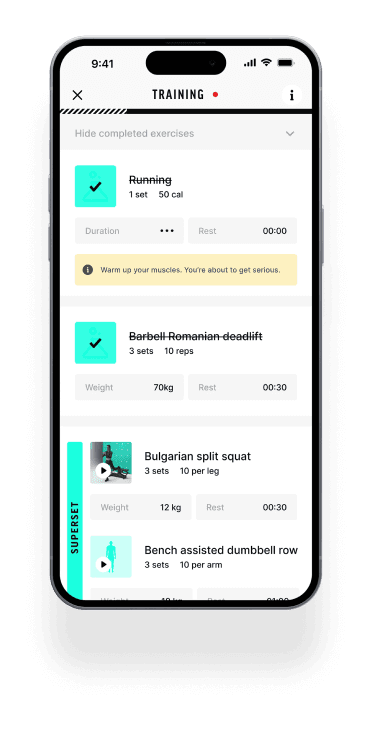
If you do the entire series of crush all records, you may encounter up to 100 different exercises. From classic strength exercises to Olympic weightlifting and from rowing machine to burpee. Below you will find at least 2 exercises that you will come across in this workout plan. The rest is ready for you in the app.
Deadlift
Als onderdeel van de "Big 3" lifts, kan een deadlift slechts in weinig schema's ontbreken. Serieus een van de beste oefeningen voor het strekken van je heup. Je bilspieren en hamstrings doen het meeste werk en bijna alle andere spieren van je lichaam zijn actief om je skelet stabiel te houden. Echt een topper van een oefening!
- 1Keep your back straight during the exercise (neutral back position).
- 2Push your buttocks back while leaning forward.
- 3Tighten your buttocks hard during the upward movement and finish upright (i.e. don't lean backward).
- 4Your feet are completely on the ground from heel to big toe throughout the movement.
Power snatch
Let bij deze oefening goed op je techniek! Als je hem onder de knie hebt is hij geweldig voor je powerontwikkeling.
- 1During the second pull phase, explosively extend your hip, knee and ankles, followed by an elevation of the scapula with your arms extended (shrug).
- 2Then dive under the bar and make sure your arms are extended as you end up in a partial overhead squat position.
Crush all records, seriously?
Breaking all your records is a serious challenge and requires a smart plan. This schedule helps you to work toward 4 main goals: more strength, higher work capacity, more power and better endurance. In order to become stronger, you need more muscle mass, and to perform all exercises properly, better mobility. In a nutshell, you will seriously be working on all aspects of your physique.
Basic principles of your workout plan
You don't break records unless you attack them. This workout schedule certainly does that, but only if you commit to it. Some rules of thumb for an effective workout:
Try to perform the exercises to the best of your ability. Technique is more important than weight.
Many weight exercises mention recommended weights. For example, BB: 60/40 kg. This means a 60-kg barbell for men and a 40-kg one for women. We deliberately list both weights, so you can do the circuits together with anyone in the gym (sometimes, the added motivation of having a training partner is very welcome 😉). Please note that both recommendations are seriously challenging. Are they too heavy for you still? Just choose a lighter weight so you can perform the exercises properly. You will automatically grow toward the weights as you break your strength records.
If the exercise doesn't list a weight, it means it's an exercise with your own body weight or a strength exercise. Under the strength exercises, it says with what weight to perform them. For example: 75% of your 1RM, or move up to a heavy 2RM in increments.
Don't be put off by abbreviations like AMRAP, EMOM or "For Time." These are there to seriously challenge you. AMRAP means: do As Many Rounds As Possible in the specified time. EMOM stands for Every Minute On The Minute: every 60 seconds, you start the indicated exercise(s). If you finish within 25 seconds, you have 35 seconds of rest before the next set begins. Last but not least, "For Time" means that you try to complete the circuit as quickly as possible.
How serious are you really?
The serious workouts will send your muscles a signal to adapt. However, they can only do this if they receive sufficient nutrients and energy. Although there is no best 'diet' for everyone, the basics are usually the same:
Create a small calorie surplus (5-10% above maintenance). Keep in mind: even more calories than that doesn't always mean more muscle growth – but it does always mean more fat gain.
Try to consume about 1.6 to 2.2 grams of protein per kilogram of body weight each day. Spread this out across at least 4 meals.
Experiment with different ratios of fats (20-35% of total calories) and carbohydrates (remaining calories). The ratio doesn't need to be super accurate, it's okay if it varies daily.
Focus on natural nutrients rich in vitamins, minerals and fibre.
We know this is a toughie but, avoid high-calorie, ultra-processed foods whenever you can. These include candy, cookies, savoury snacks, chips, pizza, chocolate, pastries, sweet dairy drinks, sodas, and sweet breakfast cereals.
Drink plenty of water, black and green tea and reduce your coffee intake.
Make sure that you are able to stick to your diet!
For specific questions, or to create a personal nutrition plan, we always recommend that you contact a qualified (sports) dietitian. Never change your entire nutrition plan by yourself. Seriously.
DOWNLOAD THE APP AND PUT THIS WORKOUT PLAN TO THE TEST. SERIOUSLY.
START TRAINING SERIOUSLY
Discover new training methods based on scientific knowledge, improve your form and technique and seriously track your fitness goals.