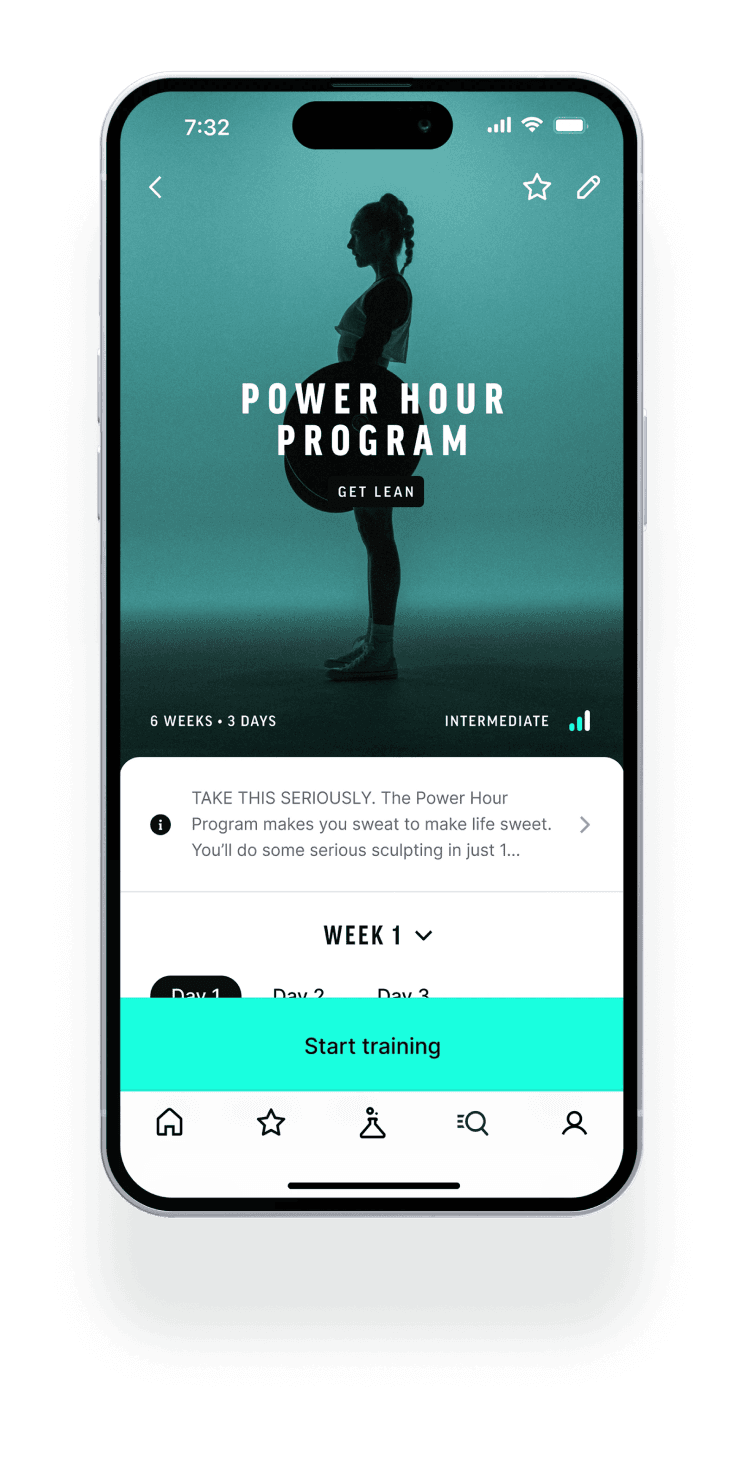
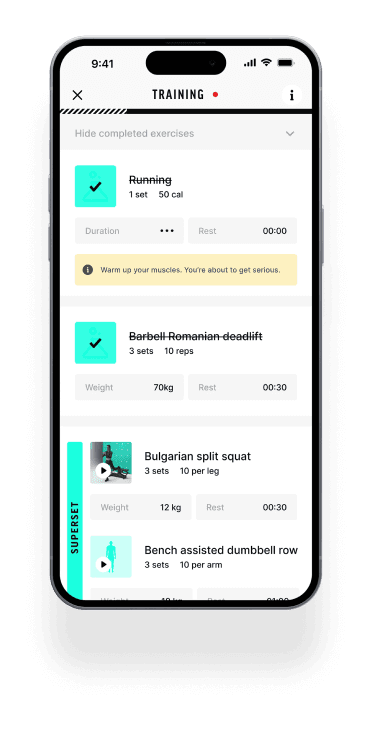
Workout plan highlights
How strong are you? When you ask this, almost everyone shows their biceps. While in the gym we all know it's about other exercises. How many kilos can you lift with the deadlift, bench press, and squat? Increasing those numbers is the goal of this workout plan. Note, the heavier the weights, the greater the risk of injuries. Technique always comes before weight and make sure to have reliable/strong spotters for 'dangerous' exercises like the bench press.
Featured exercises
When it comes to powerlifting, it's always about bench press, deadlifts, and squats. Two other equally strong exercises are often forgotten - overhead press and pull up. Of course, they are all included in this workout plan. Below we highlight 2 of them. The rest can be found in the app.
High bar squat
Een van de beste oefeningen voor je lichaam en zeker voor je benen. De high bar squat hoort eigenlijk in ieder serieus schema thuis.
- 1Place the barbell on your trapezius.
- 2Keep your back straight throughout the exercise and squat as deep as you can.
- 3Stand approximately with your feet shoulder-width apart and your toes pointing slightly outward. If you don't like this, you can experiment with a wider or narrower foot position.
- 4Your feet are always completely on the floor (from heel to toe).
Bench Press
Bench press oftewel bankdrukken, wie kent deze super oefening niet. Volgens mij behoeft hij geen introductie en staat deze oefening bij iedereen in zijn top 5 oefeningen voor borst, schouders en triceps.
- 1Grab the bar around 1.5-2x wider than shoulder width.
- 2During the exercise, keep your wrists straight and your elbows under your hands.
- 3Lower the bar under control and touch it low on your chest.
- 4Then push the bar up forcefully and bring it back over your upper chest/shoulders.
How to get seriously stronger?
There are two routes, which go together perfectly, for getting seriously stronger. Better technique makes for more efficient power transmission. Therefore, perform every repetition properly and avoid repetitions in which you fail. Next, muscle mass is the most important variable for lifting more weight. For example, larger muscle fibres in your glutes generate more power than smaller ones during a deadlift. In short, the Be Strong schedules combine specific strength training exercises (characterised by 5 reps or less and a longer rest interval) with muscle mass training exercises (6 or more reps and often in supersets combined with another exercise).
Basic principles of your workout plan: strength
Your body won't change until you seriously challenge it. This workout schedule certainly does that, but only if you commit to it. All you need to do is commit to the following two things:
When doing the exercises that require you to choose a weight, make sure you have about 1-2 reps left in the tank, unless something else is indicated. This is a leading principle. If it says 10 reps, it means that you can physically do 11-12, but still stop at 10. However – are you at rep 10 and could do exactly 4 more reps if your life were at stake? Then do 12-13 reps that set. For the next set, adjust the weight. This way, each set remains effective.
As your muscle mass grows, you'll be able to lift more weight. In order to keep challenging your muscles, the goal throughout the schedule is to continue to (slightly) increase the weight of the exercises.
Just to eliminate any doubt; when doing exercises with your own body weight, just do the number of reps indicated. Do you see 'max reps'? Then that literally means as many reps as you can do.
How serious are you really?
Let’s be serious. Muscles don't grow without a strong nutrition plan. If you want to become stronger, you will have to eat a little more than your body requires. Although there is no best ‘diet’ for everyone, the basics are usually the same:
Create a small calorie surplus (5-10% above maintenance). Keep in mind: even more calories than that doesn't always mean more muscle growth – but it does always mean more fat gain.
Try to consume about 1.6 to 2.2 grams of protein per kilogram of body weight each day. Spread this out across at least 4 meals.
Experiment with different ratios of fats (20-35% of total calories) and carbohydrates (remaining calories). The ratio doesn't need to be super accurate, it's okay if it varies daily.
Focus on natural nutrients rich in vitamins, minerals and fibre.
We know this is a toughie but, avoid high-calorie, ultra-processed foods whenever you can. These include candy, cookies, savoury snacks, chips, pizza, chocolate, pastries, sweet dairy drinks, sodas, and sweet breakfast cereals.
Drink plenty of water, black and green tea and reduce your coffee intake.
Make sure that you are able to stick to your diet!
For specific questions, or to create a personal nutrition plan, we always recommend that you contact a qualified (sports) dietitian. Never change your entire nutrition plan by yourself. Seriously.
DOWNLOAD THE APP AND PUT THIS WORKOUT PLAN TO THE TEST. SERIOUSLY.
START TRAINING SERIOUSLY
Discover new training methods based on scientific knowledge, improve your form and technique and seriously track your fitness goals.